
Performance & Bench Development Maturity Levels
Most dealer groups don’t struggle because of effort.
They struggle because there is no system connecting performance to development.
Every store is measured on results. Hitting targets. Driving gross. Managing expenses. But what sits underneath those results is what actually determines whether performance is consistent or unpredictable.
That is how your managers coach, develop, and build their people.
When that system is inconsistent, performance becomes inconsistent. When that system is strong, performance becomes predictable and your bench becomes real.
The difference comes down to where your dealer group sits on the Performance & Bench Development Maturity Levels.
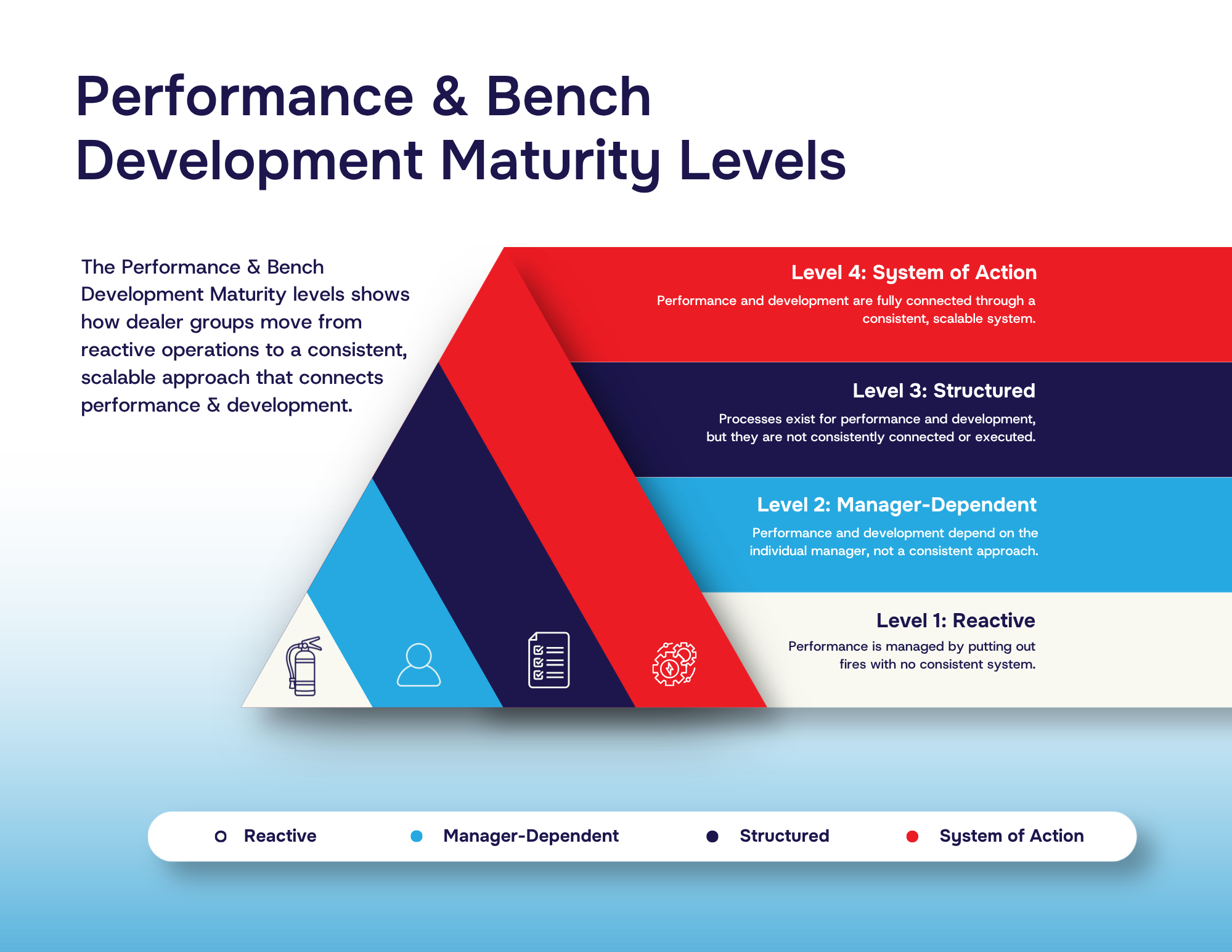
Level 1: Reactive
At this level, performance is only reviewed when numbers drop. 1:1s are inconsistent or do not happen at all. Coaching is based on instinct rather than data, and there is no clear development path for employees.
Managers are in constant firefighting mode. There is effort, but no system behind it.
The result is inconsistent performance, high frustration, and no real bench to rely on.
Level 2: Manager-Dependent
At this level, some managers run strong 1:1s, while others do not. Coaching quality varies by store or department. High performers develop, but only under strong managers. Promotion decisions are often subjective.
Performance and development depend on who the manager is, not how the system runs.
The result is pockets of success, but no consistency across the group. Bench strength exists in places, but it is not reliable.
Level 3: Structured
At this level, 1:1s are scheduled and expected. Performance metrics are defined, and managers are beginning to coach to specific areas. Development is discussed, but it is not always tracked or followed through.
A system is forming, but it is not fully connected.
The result is improved performance, some visibility into development, and early signs of bench strength.
Level 4: System of Action
At this level, performance and development are fully connected. Every 1:1 starts with performance data. Coaching is tied to specific gaps, and every meeting leads to clear next actions.
Development toward the next role is actively tracked, and leaders can clearly see who is improving and who is ready.
The result is consistent performance across stores, scalable coaching, and a real, promotable bench.
Where does your dealer group stand?
Most dealer groups believe they are further along than they actually are.
The reality shows up in the day-to-day.
- Are 1:1s happening consistently?
- Are managers coaching to specific gaps?
- Is development toward the next role clear?
- Can you confidently say who is ready to be promoted?
If those answers vary across stores, you are not operating a system yet.
Why this matters
High performance is visible.
You can see it in the numbers.
Bench strength is different. It is built over time through consistent coaching, clear expectations, and structured development.
Without that, performance depends on the manager. With it, performance scales across the group.

.png)